Author: editor

  • Icons and Mandalas — Gazing into symbols that speak beyond words

    Icons and Mandalas — Gazing into symbols that speak beyond words

    Throughout history, mankind has employed symbols and art forms to express concepts that transcend verbal communication. Among these, icons and mandalas stand out as powerful examples of metaphysical representation, each carrying profound significance in its respective cultural milieu.

    The World of Icons

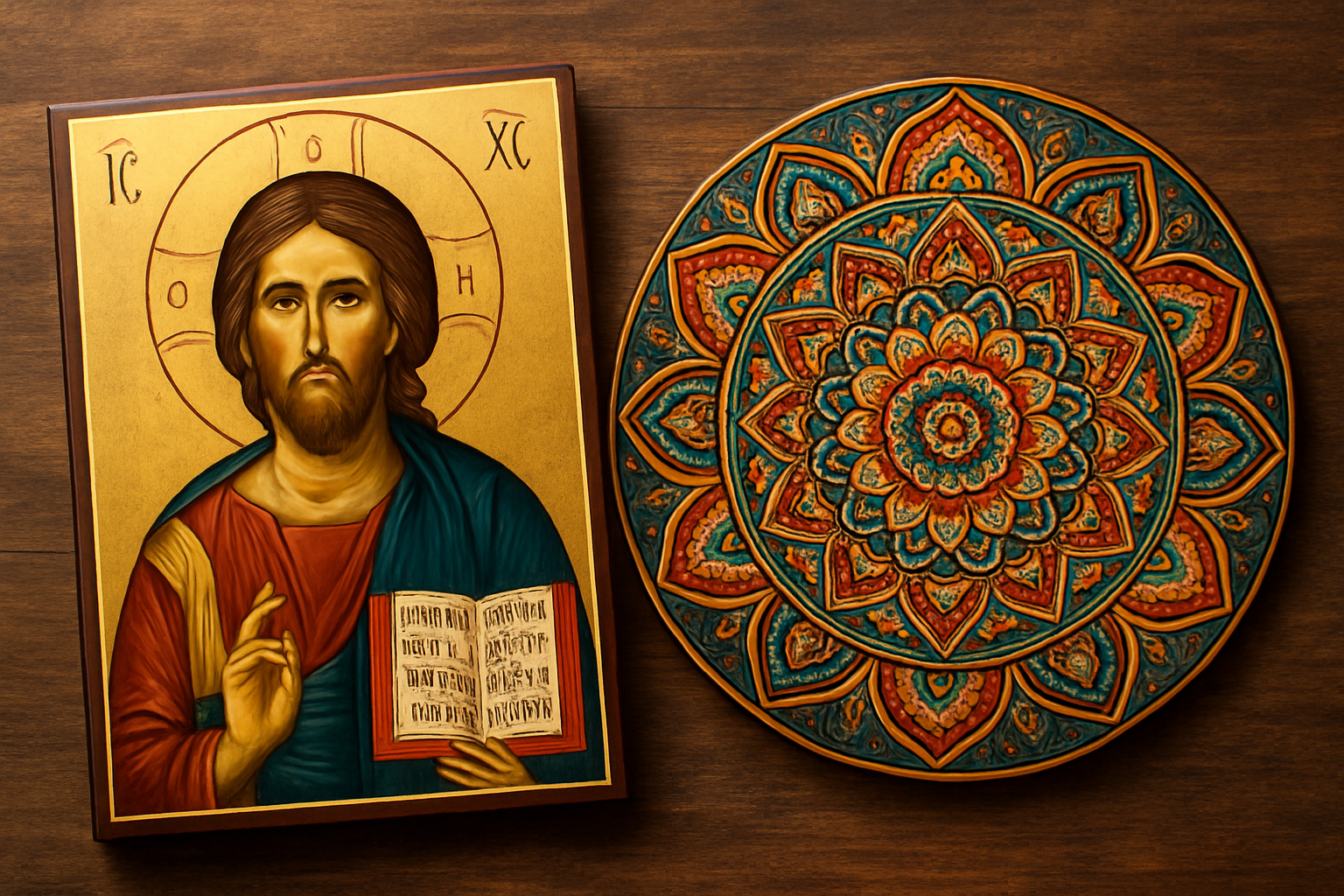
    Icons, typically associated with religious art, serve as a visual language in many spiritual traditions. In Eastern Orthodox Christianity, for instance, icons are not mere depictions but are considered windows to the divine.

    “An icon is a sacred image used in religious devotion… The icon is a means of spiritual communion between the viewer and the image.” — OrthodoxWiki

    These sacred images, often rendered in a stylized manner with rich symbolism, invite the viewer into contemplation and prayer. Icons are not only art but are revered as expressions of theological insights, with each detail carrying a symbolic meaning understood by the believers.

    The Mandala’s Encompassing Nature

    Meanwhile, the mandala, often associated with Buddhist and Hindu traditions, offers a cosmic diagram of the universe. The word “mandala” comes from the ancient Indian language of Sanskrit and means “circle.”

    “In various spiritual traditions, mandalas may be employed for focusing attention, as a spiritual teaching tool, or for establishing a sacred space.” — Encyclopaedia Britannica

    Mandalas often take the form of intricate geometric patterns, symbolizing the universe’s structure and unity. They are used in meditation practices, guiding the practitioner’s focus inward and deeper into the spiritual realm. Drawing or gazing upon a mandala is said to aid in centering the mind and promoting spiritual healing and growth.

    Universal Symbols of Unity

    Both icons and mandalas invite individuals into an interaction with the infinite, creating a bridge between the earthly and the divine. While they originate from distinct cultural backgrounds, they share an underlying principle: they serve as instruments for personal transformation and paths to enlightenment.

    • Icons articulate theological truths through visual storytelling.
    • Mandalas illustrate the cosmic order through symmetrical patterns.

    In a world often overwhelmed by too many words, these symbolic formats allow us to experience a purer, more profound understanding of our place within the cosmos. The eye-catching allure of icons and mandalas holds timeless appeal, perpetually inviting us to explore deeper spiritual dimensions beyond the realm of verbal expression.

    For more on the symbolism of icons and mandalas, visit Orthodox Arts Journal and Shambhala Publications.
  • Walking with Christ, Walking with the Buddha — Pilgrimage as an inner journey

    Walking with Christ, Walking with the Buddha — Pilgrimage as an inner journey

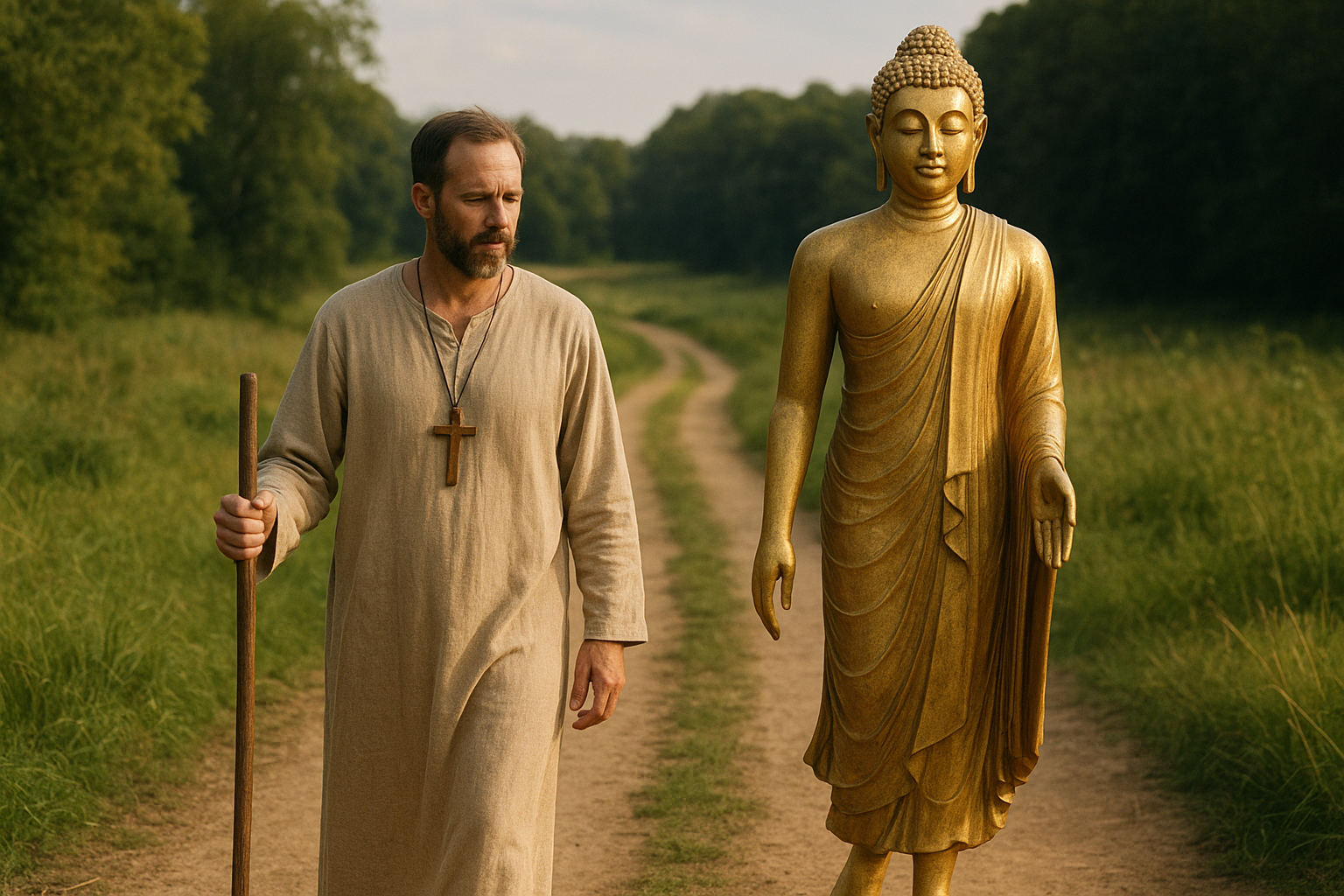
    Pilgrimage has been a sacred practice across cultures and religions, offering believers a path to both an outer journey through sacred landscapes and an inner journey toward spiritual awakening. Whether following in the footsteps of Christ or tracing the path laid by the Buddha, the act of pilgrimage can transform the heart and soul, aligning the physical journey with a profound spiritual quest.

    The Significance of Pilgrimage

    Pilgrimage, in both Christian and Buddhist traditions, extends beyond mere travel. It is an act of devotion, penance, and search for deeper meaning. Pilgrims leave the comfort of daily life to immerse themselves in uncertainty, challenge, and ultimately, spiritual growth.

    • Physical Journey: Physical hardships faced during pilgrimage often mirror the challenges of life, teaching resilience and humility.
    • Mental Reflection: The solitude of pilgrimage offers space for introspection, helping pilgrims confront personal truths.
    • Spiritual Transformation: Encountering holy places and engaging in prayer and meditation facilitates a deeper connection with the divine.

    As Thomas Merton expressed, “The geographical pilgrimage is the symbolic acting out of an inner journey. The inner journey is the interpolation of our soul’s curiosity and a deep connection with what lies beyond our daily perception.”

    Pilgrimage in Christianity

    In the Christian tradition, pilgrimage has been associated with the quest for divine forgiveness and a closer relationship with God. Historic Christian pilgrimages often lead to Jerusalem, Rome, Santiago de Compostela, and other holy sites. The act of walking where Christ or His saints walked serves as an inspiration and a tangible link to faith.

    “Blessed are those whose strength is in you, whose hearts are set on pilgrimage.” – Psalm 84:5

    The route to Santiago de Compostela, known as the Camino de Santiago, is one of the most famous Christian pilgrimages. Pilgrims walk hundreds of miles to the cathedral where Saint James is said to be buried, experiencing both community and solitude along the way.

    “When I went to that pilgrimage, I carried a heavy burden, but I returned with my soul lightened and my steps ready for the new life ahead,” shares one pilgrim about her journey on the Camino.

    Buddhist Pilgrimage

    In Buddhism, the pilgrimage is often centered on visiting sites connected to the life of Siddhartha Gautama, the Buddha. These sites, such as Lumbini (birthplace), Bodh Gaya (place of enlightenment), Sarnath (first sermon), and Kushinagar (death), are revered as places for meditation and reflection.

    1. Lumbini: Located in present-day Nepal, this sacred garden is recognized as the birthplace of the Buddha.
    2. Bodh Gaya: Under the Bodhi Tree, Siddhartha attained enlightenment and became the Buddha. Pilgrims meditate here, seeking their own insights.
    3. Sarnath: The site of the first sermon symbolizes the Buddha’s mission to spread his teachings.
    4. Kushinagar: The place where the Buddha attained Parinirvana, marking the final release from the cycle of rebirth.

    In Buddhism, the pilgrimage goes beyond the act of visiting. It is a path to enlightenment through the practice of the Buddha’s teachings. As the Dalai Lama notes, “A pilgrimage is not just about visiting holy sites; it is about opening your heart and attuning to the compassion that the Buddha exemplifies.”

    Commonalities in Pilgrimage

    Despite their differences, Christian and Buddhist pilgrimages share profound commonalities:

    • Purpose: Both are quests for spiritual growth, introspection, and a deeper connection with the sacred.
    • Ritual: Rituals and prayers enhance the experience, grounding pilgrims in their spiritual traditions.
    • Transformation: The journey itself becomes a transformative process, altering one’s perception of self and life.

    Pilgrimages encourage believers to step outside their comfort zones, pushing them towards spiritual awakening. As the poet T.S. Eliot eloquently stated, “The end of all our exploring will be to arrive where we started and know the place for the first time.”

    The Inner Journey

    Ultimately, pilgrimage serves as a metaphor for the inner journey each person must embark upon to attain peace and enlightenment within. It is where the outer path and inner exploration converge, fostering an experience that melds body, mind, and spirit. Whether walking in the footsteps of Jesus or tracing the Buddha’s paths, the ultimate goal is self-discovery and spiritual fulfillment.

    In the words of Joseph Campbell, “A sacred place is an extraordinary place, for it is at such a place that one finds one’s true self.” Pilgrimage as an inner journey offers a path toward this sacred self-awareness, guiding pilgrims to find harmony within and embrace the divine presence in all things.

    By engaging with the act of pilgrimage, individuals accept a sacred calling: to walk with Christ, to walk with the Buddha, and ultimately, to walk the path of the heart.

    For more insights on pilgrimage, visit National Geographic – Pilgrimage.

  • The Beatitudes and the Noble Truths — Blessing and suffering as shared doorways

    The Beatitudes and the Noble Truths — Blessing and suffering as shared doorways

    Throughout history, humanity has grappled with the concepts of suffering and blessings, often finding resonance in religious and philosophical teachings. Two profound approaches to understanding these themes are found in Christianity’s Beatitudes and Buddhism’s Four Noble Truths. Although rooted in different traditions, these teachings share a remarkable thematic overlap that bridges cultures and underscores a common human experience.

    The Beatitudes

    The Beatitudes are a series of teachings by Jesus as part of the Sermon on the Mount, found in the Gospel of Matthew. These proclamations reveal a radical understanding of happiness and blessing. As highlighted by theologian N.T. Wright, “The Beatitudes are Jesus’ way of announcing a new reality, where the kingdom of heaven rules.”

    • Blessed are the poor in spirit, for theirs is the kingdom of heaven.
    • Blessed are those who mourn, for they shall be comforted.
    • Blessed are the meek, for they shall inherit the earth.
    • Blessed are those who hunger and thirst for righteousness, for they shall be filled.
    • Blessed are the merciful, for they shall obtain mercy.
    • Blessed are the pure in heart, for they shall see God.
    • Blessed are the peacemakers, for they shall be called the children of God.
    • Blessed are those who are persecuted for righteousness’ sake, for theirs is the kingdom of heaven.

    Each Beatitude begins with a paradoxical blessing, inviting followers to find divine rewards in experiences typically seen as hardships or setbacks. Far from offering a detached idealism, they call for active engagement in the world through humility, mourning, and peacemaking.

    The Four Noble Truths

    In contrast, the Buddhist path is crystallized in the Four Noble Truths, first taught by Siddhartha Gautama, the Buddha. These truths fundamentally revolve around the nature of suffering, its origin, cessation, and the path leading to its cessation:

    • Dukkha: Recognizing that suffering exists and is an unavoidable part of life.
    • Samudaya: Understanding that suffering arises from desire and attachment.
    • Nirodha: Realizing that ending attachment can end suffering.
    • Magga: Following the Eightfold Path as means to cease suffering.

    “The Four Noble Truths encapsulate the understanding of suffering and its cessation, providing a practical framework for liberating oneself from the binds of sorrow”
    (Barbara O’Brien, Learn Religions).

    The aim is to foster a profound understanding and eventual transcendence of suffering through mindful living, insight, and ethical conduct.

    Common Ground

    While one might find it easy to dwell on the differences between Christianity and Buddhism, a fascinating common ground emerges: both traditions invite their adherents to engage deeply with experiences of suffering as pathways to deeper blessings or understanding.

    In the Beatitudes, suffering is blessed because it positions believers within God’s kingdom, offering solace and faith as direct benefits to virtue and endurance. Meanwhile, the Four Noble Truths illuminate how suffering can be a vehicle for enlightenment, thereby offering intrinsic liberation from the worldly cycle of pain.

    Both teachings encourage a transformation of perspective. Jesus, through the Beatitudes, reorients what it means to be blessed, unveiling inherent spiritual wealth often hidden in adversity. Similarly, Buddha reinterprets suffering not as a fate to endure but a condition ripe for transformation through self-awareness and ethical living.

    Bringing Two Paths Together

    While the methods and underlying spiritual contexts differ, both paths meet at the intersection of inward change and outward behavior. The Beatitudes call for empathy and active mercy, while the Noble Truths advocate for compassion and non-attachment.

    “No true path shall reject another, for all aim for what is above the worldly realm”
    (Richard Temple, The New York Times).

    Incorporating lessons from both can enrich one’s spiritual journey, offering a more holistic understanding of what it means to be truly blessed amidst suffering. The focus shifts from escape to transformation, moving from avoidance of pain to embracing the full spectrum of the human experience with a heart centered in righteousness and awareness.

    In a world marked by varied struggles, the teachings of the Beatitudes and the Four Noble Truths serve as poignant reminders of the shared human quest for meaning — through suffering towards enlightenment, through adversity towards blessing.

  • Compassion and Agape — The heart learning to open in two traditions

    Compassion and Agape — The heart learning to open in two traditions

    The concepts of compassion in Buddhist traditions and agape in Christian teachings offer profound insights into the ways hearts can learn to open toward others. These traditions, although distinct in their cultural and historical contexts, converge on essential human values that aspire to transcend individual limitations.

    Understanding Compassion in Buddhism

    In Buddhism, compassion, or karuna, is a fundamental principle that guides practitioners toward enlightenment. It involves not only acknowledging the suffering of others but also taking actionable steps to alleviate it. As the Dalai Lama once stated:

    “If you want others to be happy, practice compassion. If you want to be happy, practice compassion.”

    This teaching emphasizes that opening one’s heart to the pain and struggles of others can forge a connection that enriches both the giver and the receiver. Compassion is seen not just as an emotional response, but as a deliberate choice that transforms suffering into an opportunity for communal healing and growth.

    The Essence of Agape in Christianity

    Agape, in contrast, is a term derived from Ancient Greek, often used in Christian texts to describe a form of unconditional love that mirrors the love of God for humanity. It is a selfless love that seeks the welfare of others beyond personal gain. In 1 Corinthians 13:4-7, agape is illustrated with enduring qualities:

    “Love is patient, love is kind. It does not envy, it does not boast, it is not proud. It does not dishonor others, it is not self-seeking, it is not easily angered, it keeps no record of wrongs.”

    Agape challenges individuals to reach beyond their comfort zones, providing care and support without expecting anything in return, and thus opening the heart in a transformative way.

    Bridging the Traditions

    While stemming from distinct spiritual practices, both compassion and agape encourage individuals to develop an open heart. They challenge followers to transcend selfish perspectives and to actively engage in the well-being of others. As Thich Nhat Hanh, a Vietnamese Buddhist monk and peace activist, eloquently expressed:

    “Through my love for you, I want to express my love for the whole cosmos, the whole of humanity, and all beings.”

    Understanding these teachings offers a roadmap to cultivating a more open and empathetic heart in a world that often emphasizes division over unity.

  • Silence as a Sacred Teacher — Listening where words fall away

    Silence as a Sacred Teacher — Listening where words fall away

    In an era dominated by the constant chatter of social media, the incessant hum of technology, and the relentless pace of modern life, silence stands as a profound sanctuary. It is within this silence that we find a space to listen, not just with our ears, but with our heart and soul.

    The Essence of Silence

    Silence is often viewed as simply the absence of sound, yet for those who seek its wisdom, it is much more. It is the absence of noise that allows the presence of clarity, peace, and introspection. The space created by silence can be both comforting and intimidating, offering a mirror to our innermost thoughts.

    “Silence is not the absence of something, but the presence of everything.” — Gordon Hempton, acoustic ecologist.

    Learning to Listen

    In silence, we learn the art of listening — a skill essential for personal growth and spiritual development. Listening in silence is not about hearing words but about perceiving the subtle cues of the universe and our inner self. It is about attuning to the whispers of intuition and the gentle nudges of our conscience.

    • Inner Reflection: Silence provides the perfect backdrop for introspection and reflection. It is here that we confront our true selves and understand our deepest desires and fears.
    • Emotional Healing: In silence, unresolved emotions rise to the surface, allowing us to acknowledge and heal from them. This is a crucial step in our journey toward emotional well-being.
    • Creative Inspiration: Many artists and thinkers have found inspiration in silence. It offers a clean slate, free from distractions, where creativity can flourish.

    The Practice of Silence

    Practicing silence requires intention and discipline. Setting aside time each day for a period of quietude can transform our lives. Whether through meditation, a walk in nature, or simply sitting in stillness, engaging with silence can deepen our understanding of ourselves and the world.

    Mindful practices in silence help cultivate a deeper connection with the present moment, enhancing our overall quality of life. The benefits extend beyond the individual, introducing a ripple effect of calm and presence in our interactions with others.

    Conclusion

    Silence, as a sacred teacher, offers lessons that resonate beyond words. It invites us to listen to the once unheard, see the once unseen, and understand the once misunderstood. In embracing this sacred space, we allow ourselves the opportunity to experience profound transformation and growth.

  • Kenosis and Sunyata — Letting go into the vastness of love

    Kenosis and Sunyata — Letting go into the vastness of love

    In the realm of spiritual practice and philosophy, the concepts of Kenosis and Sunyata offer profound insights into the art of letting go and embracing the vastness of love. Though they hail from different traditions—Christianity and Buddhism respectively—both ideas converge on the path of emptying the self to connect with a deeper truth.

    Understanding Kenosis: The Christian Paradigm

    Kenosis is a Greek term meaning “self-emptying” and is often associated with the Christian narrative of Jesus, who emptied himself of divine privilege to become human. This concept is articulated in Paul’s letter to the Philippians:

    “Have this mind among yourselves, which is yours in Christ Jesus, who, though he was in the form of God, did not count equality with God a thing to be grasped, but emptied himself, by taking the form of a servant, being born in the likeness of men.”
    — Philippians 2:5-7 (ESV)

    In essence, Kenosis calls for a radical act of humility and surrender, encouraging individuals to let go of the ego to align more closely with divine love and service. This self-emptying is not about destruction but transformation, allowing the divine nature within to flourish.

    Sunyata: The Buddhist Experience of Emptiness

    In contrast, Sunyata, often translated as “emptiness,” is a key concept in Buddhist philosophy. It denotes the absence of inherent existence in all phenomena, illustrating the interdependent nature of reality. Renowned Buddhist teacher Thich Nhat Hanh explains:

    “Emptiness does not mean nonexistence. It means interdependent co-arising, the interbeing of all things. Because everything is empty of a separate self, everything exists in the context of everything else.”
    — Thich Nhat Hanh

    Through practicing Sunyata, individuals experience freedom from attachment, understanding that our grasp on things as permanent and independent is an illusion. This realization can lead to a profound sense of peace and love for all beings.

    The Intersection of Kenosis and Sunyata

    Despite their different origins, Kenosis and Sunyata share striking similarities:

    • Letting Go: Both practices emphasize the importance of surrendering the ego. In Kenosis, it is the relinquishment of self-importance and divine prerogatives, while in Sunyata, it is the release from the illusion of a permanent self.
    • Embracing the Present: They encourage a deep presence in the moment. Kenosis involves embodying the humility of Christ, while Sunyata invites practitioners to experience the interconnectedness of all life here and now.
    • Path to Love: By emptying oneself, both traditions reveal a path to profound love—Kenosis through divine union, and Sunyata through compassionate wisdom.

    Practical Steps to Cultivate Kenosis and Sunyata

    For those looking to incorporate these concepts into daily life, consider the following practices:

    • Meditation: Regular meditation can help cultivate a mindset of surrender and presence. Focus on silent meditation sessions to reduce ego-driven thoughts.
    • Service: Following the kenotic example of Jesus, engage in acts of service and charity. Serving others selflessly is a powerful way to practice Kenosis.
    • Mindfulness: Develop mindfulness to perceive the interdependence of all things, a reminder of Sunyata. Notice how every action impacts the whole.

    Personal Reflections and Modern Applications

    The relevance of Kenosis and Sunyata extends beyond theology and philosophy into contemporary life, where ego-driven pursuits often overshadow deeper connections. By embracing these practices, individuals can foster a more harmonious society centered on love and compassion.

    Modern spiritual leaders emphasize integrating these concepts into personal growth and societal development:

    “The spiritual journey is one that requires us to let go of everything we know and be open to everything we don’t. True spiritual growth is about emptying ourselves to discover the interconnectedness of all life.”
    Matthew Fox, theologian

    Conclusion: Embracing the Vastness of Love

    Both Kenosis and Sunyata offer pathways to experience the vast, transformative power of love. By letting go of the constructed self, individuals can tap into a profound source of empathy, compassion, and interconnectedness. Whether through the lens of Christian or Buddhist practice, the journey inward essential for realizing the boundless potential of love.

    Ultimately, these ancient practices remind us that by emptying ourselves, we become full of love— for ourselves, for others, and for the world.

  • Breath Prayer and Mindfulness — Two languages of the same attentive breathing

    Breath Prayer and Mindfulness — Two languages of the same attentive breathing

    In a world bustling with distractions and demands, finding moments of peace can seem a formidable challenge. Yet, the ancient practices of breath prayer and mindfulness offer two paths to tranquility, each weaving attentive breathing into their fabric. Despite their different origins, both practices serve as languages addressing the same core need: cultivating presence through the simple act of focused breathing.

    The Origin of Breath Prayer

    Breath prayer is rooted in the Christian tradition and has been a part of spiritual practice for centuries. It is a form of prayer where breathing is synchronized with short, repetitive prayers or phrases. This form of prayer is particularly associated with the traditions of the Eastern Orthodox Church. As Britannica notes, the Jesus Prayer is a common example, often recited as “Lord Jesus Christ, Son of God, have mercy on me, a sinner” rhythmically in tandem with one’s breath.

    Breath prayer supports a spiritual focus, encouraging practitioners to engage in a form of meditation that draws them closer to the divine. By aligning each breath with a prayerful intention, participants cultivate a stillness that permeates body and mind, helping to anchor their spirituality in daily life.

    The Practice of Mindfulness

    Mindfulness, on the other hand, has roots in Buddhist traditions, though its modern application is secular and widely embraced across diverse cultures. Mindfulness is about bringing one’s attention to the present moment without judgment, often using the breath as a focal point. As Mindful magazine elucidates, the practice encourages noticing thoughts, feelings, and sensations as they arise, fostering a greater awareness and acceptance of one’s internal and external experiences.

    Practicing mindfulness can lead to reduced stress, improved clarity, and enhanced emotional regulation. By simply observing the breath and acknowledging the present moment, individuals can step back from persistent worry and anxiety, engaging more fully with life as it unfolds.

    Similarities and Synergies

    Despite differing origins, breath prayer and mindfulness share significant overlaps:

    • Focused Breathing: Both practices use the breath as a central tool, emphasizing its power to ground and focus the mind.
    • Encouragement of Presence: Whether in a spiritual or secular context, both encourage an attentive state of being, fostering internal peace and clarity.
    • Stress Reduction: Engaging in either practice can lead to decreased stress levels, improved mental health, and overall well-being.

    “Mindfulness practice teaches us to respond with compassion and wisdom,” writes Seth Gillihan, Ph.D., illustrating its calming and centering effects, akin to the intent behind breath prayer.

    Divergence and Accessibility

    While these practices can complement one another, key differences remain:

    • Spiritual vs. Secular: Breath prayer is inherently spiritual, intended to connect practitioners with their faith, whereas mindfulness often lacks religious connotations, making it accessible to a wider audience.
    • Structure vs. Freedom: Breath prayer involves structured phrases, whereas mindfulness typically allows space for observing thoughts without the need for specific verbiage.

    Despite these distinctions, the practices can coexist harmoniously, offering individuals the choice of accessible methods for cultivating mindfulness and tranquility.

    Integrating Attentive Breathing into Daily Life

    Both practices can be seamlessly integrated into daily routines:

    • Start Small: Begin with a few minutes each day, gradually increasing the time as comfort grows.
    • Consistency is Key: Make a habit of your chosen practice, whether by starting a day with breath prayer or setting aside quiet time for mindfulness meditation.
    • Find Community: Joining a group, attending workshops, or even following guided sessions online can provide support and enhance understanding.

    Ultimately, the shared language of breath prayer and mindfulness is the attentive breath itself—a bridge connecting physical presence with either spiritual contemplation or mindful awareness. By exploring these paths, individuals can nurture a profound level of inner peace, responding to life’s challenges with clarity and grace.

  • The Cross and the Empty Circle — Meeting surrender and emptiness in the heart’s silence

    The Cross and the Empty Circle — Meeting surrender and emptiness in the heart’s silence

    The Cross and the Empty Circle — Meeting Surrender and Emptiness in the Heart’s Silence

    Throughout human history, symbols have served as profound vessels of meaning, unlocking secrets of the spiritual realm and guiding souls towards deeper understanding. Among such symbols, the cross and the empty circle stand out as metaphors for surrender and emptiness, pathways to profound inner silence. This article seeks to explore these archetypes, rooted in rich traditions and teachings, and how they can guide us to the tranquil center of the heart.

    The Cross: A Symbol of Surrender

    The cross, a universal symbol seen in various forms across different cultures, is most prominently associated with Christianity. It represents the crucifixion of Jesus Christ, an act of ultimate surrender and sacrifice. In Christian spirituality, the cross is more than just a representation of suffering; it is a symbol of the path of redemption through surrender.

    “For God so loved the world that he gave his one and only Son, that whoever believes in him shall not perish but have eternal life.” — John 3:16

    The act of surrender on the cross is a profound invitation to relinquish personal will in favor of a higher purpose. It embodies vulnerability and trust in the face of the unknown. As believers meditate on the cross, they are reminded that surrender is not defeat but a gateway to spiritual renewal and profound peace.

    • Surrender in Tradition: The symbolism of the cross is far-reaching, appearing in various forms, from the Celtic cross to the ankh of Ancient Egypt, each representing a connection to the divine and the harmony of opposites.
    • Personal Reflection: Invoking the image of the cross in moments of meditation can facilitate personal transformation, encouraging individuals to let go of ego-driven desires.

    Beyond its religious connotations, the cross serves as a tool for spiritual growth. It invites individuals to confront their pain, acknowledge it, and transform it through love and forgiveness.

    The Empty Circle: Embracing Emptiness

    In stark contrast to the cross stands the empty circle, a symbol frequently associated with Zen Buddhism and Taoism. The circle, often referred to as the Enso, represents enlightenment, the universe, and the void. It embodies the notion of emptiness, a concept pivotal in Eastern philosophy.

    “Form is emptiness, emptiness is form.” — The Heart Sutra

    In Buddhism, emptiness is not a void of nothingness but a space of infinite potential. It is the recognition that all things are interconnected, devoid of inherent self. Through understanding emptiness, one learns to let go of attachments and embrace the flow of life.

    • Understanding Emptiness: In Zen, the Enso is often drawn in a single brushstroke, encapsulating the moment of complete focus and the letting go of self-consciousness.
    • Empty Circle in Practice: Practitioners use the Enso as a meditative focal point, a means to touch the essence of being beyond thought and ego.

    The empty circle is an invitation to step into the silence of the heart, where the chatter of the mind is quieted, and one can rest in the present moment.

    Intersection of Surrender and Emptiness

    At first glance, the cross and the empty circle may seem to represent opposing principles. However, they both guide practitioners to a similar state of spiritual awakening through different pathways.

    “True happiness is found in surrendering our heart to these very simple, yet profound practices.” — Pema Chödrön

    • Inner Silence: The surrender symbolized by the cross encourages letting go of the ego, while the emptiness of the circle invites openness. Both result in a serene heart open to divine wisdom.
    • Unification: By embracing both symbols, one can achieve a balance, stepping into the silence where the heart speaks without noise.

    These practices remind us that true power comes from embracing vulnerability, and enlightenment from embracing emptiness. Each symbolizes a part of the spiritual journey towards peace.

    Practices for Integrating the Cross and the Empty Circle

    To integrate the teachings of the cross and the empty circle into daily life, individuals can engage in practices that foster surrender and openness. Some suggestions include:

    • Meditative Reflection: Spend time focusing on images of the cross and the Enso. Contemplate their meanings and how they resonate within your life.
    • Breath Work: Use deep breathing to connect to the present moment, aligning with the surrender of the cross and the openness of the empty circle.
    • Journaling: Write about personal experiences of surrendering control or embracing emptiness, noting any insights or feelings that arise.

    By engaging in these reflective practices, individuals can deepen their understanding of these symbols, using them as anchors in the chaotic waters of everyday life.

    Conclusion: Meeting in the Heart’s Silence

    The cross and the empty circle, though distinct in their cultural origins and philosophical foundations, converge in the heart, leading us to the same truth—the necessity of silence and surrender in spiritual awakening. Embracing both symbols enables a journey toward inner peace, where the heart can listen and speak its quiet language.

    Ultimately, the meeting of the cross and the empty circle within the heart invites us to live a life of compassion, openness, and unyielding love, transcending the ordinary and touching the divine.

    For further reading, consider exploring the writings of Thich Nhat Hanh and Pema Chödrön, who offer profound insights into the heart’s silence and the journey of the spirit.

  • The Silence of Nirvana and the Voice of the Creator

    The Silence of Nirvana and the Voice of the Creator

    Buddhism is, without question, one of the most noble traditions humanity has produced. Its followers are often recognized for their gentleness, their moral discipline, and their compassion toward all living beings. The principle of ahimsa (non-harm) reflects a profound respect for life, and the cultivation of virtues such as patience, equanimity, and self-restraint has inspired countless generations. The practices of meditation, too, reveal an extraordinary refinement of the inner life, a dedication to clarity, insight, and freedom from illusion that commands the respect even of those outside the tradition.

    In addition to this, Buddhism and its later flowering in Zen have always held a deep sense of the poetic and the symbolic. They excel in parable, image, and gesture. Their myths of the Bodhisattvas, their tales of masters and disciples, their metaphors of awakening—all these have touched hearts with a beauty that is at once profound and simple. In this sense, Buddhism shows how myth can carry truth in a way reason alone cannot.

    And yet, for all its beauty, something crucial is missing. Buddhism does not confess a Creator-God, nor does it preserve a myth of creation. Its myths are moving, but they are not ultimate. They speak of cycles of rebirth, of karmic law, of Buddhas appearing in many worlds, but they do not speak of the Origin of all things, nor of the divine purpose that gives creation its direction. In this sense, the path, however noble, ends in a blind alley. For myth without creation cannot finally answer the question of why anything exists at all, nor can it show the personal bond between Creator and creature that underlies our longing for consummation.

    This absence has haunted Buddhism’s own self-understanding. For centuries, debate has raged within the schools: what exactly did the Buddha attain? Was Nirvana an extinction, a passing beyond, an ineffable silence, or something else altogether? No consensus has ever been reached. Without a Creator, the goal remains undefined, and the myths that do exist cannot point to a final fulfillment.

    From the perspective of faith in God, one can see both the greatness and the limitation of this tradition. The compassion, discipline, and wisdom of Buddhists are real and admirable; they testify to the divine law written on the human heart. Their myths, too, testify to the human need for meaning and transcendence. But without the myth of creation—without the recognition of God as the Origin and End—all of these virtues and all of these stories remain suspended, beautiful but incomplete.

    Thus, Buddhism and Zen show the heights of human striving, the beauty of moral character, and the poetry of myth. Yet without the Creator, their path cannot reach its destination. For myth without creation is myth without consummation, and discipline without God is a road that cannot finally lead beyond itself. Only when the myth of creation is joined to the living Creator can the virtues and visions of Buddhism find their true fulfillment in the fullness of truth and love.