Author: editor

  • Zen of the Infinite: Practical Steps to Cosmic Spirituality

    Zen of the Infinite: Practical Steps to Cosmic Spirituality

    In a world brimming with chaos and constant distractions, the quest for peace and deeper understanding of the universe becomes a magnetic pull for many. The intertwining of Zen philosophy with an expansive view of cosmic spirituality offers a transformative path to enlightenment and self-realization. This journey is not about transcending human experience but, rather, embracing it with a cosmic perspective.

    Zen of the Infinite entails harmonizing your inner world with the vast universe. By aligning with the cosmos, you can achieve a profound connection with not only yourself but everything that surrounds you. Here, we explore practical steps toward nurturing this spiritual connection.

    Understanding Zen and Cosmic Spirituality

    Zen, a school of Mahayana Buddhism, emphasizes meditation and intuition over ritual worship and scripture. Renowned philosopher D.T. Suzuki describes Zen as “a special transmission outside the scriptures; no dependence upon words and letters; direct pointing to the soul of man.” It is about going beyond the physical and embracing mindfulness in every moment.

    On the other hand, cosmic spirituality seeks to understand our relationship with the universe. It invites us to explore the interconnectedness of all beings and phenomena through a spiritual lens, recognizing our ties to the greater cosmos.

    Practical Steps to Achieve Cosmic Spirituality

    1. Begin with Meditation

    • Meditation is the cornerstone of the Zen practice and is equally critical in cosmic spirituality. It cultivates a state of presence, paving the way to a deeper cosmic experience. Start with simple Zazen meditation, focusing on breath and posture.

    • According to Zen master Shunryu Suzuki, author of Zen Mind, Beginner’s Mind, “In the beginner’s mind there are many possibilities, but in the expert’s there are few.” Let go of misconceptions and approach meditation with a fresh perspective.

    2. Practice Mindful Living

    • Mindfulness is integral to both absorbing the essence of Zen and attuning to cosmic spirituality. Engage in activities such as mindful walking, eating, or breathing exercises to stay anchored in the present moment.

    • Thich Nhat Hanh, a venerable Zen monk and peace activist, urges that “The miracle is not to walk on water. The miracle is to walk on Earth.” Embrace each moment as a miracle to nourish your cosmic consciousness.

    3. Connect with Nature

    • Nurture your connection with the natural world, which is a manifestation of universal energy. Spend time outdoors, admire the night sky, or plant a garden to deepen your relationship with the cosmos.

    • Take notes from Alex Grey, visionary artist whose works portray interconnectedness through striking cosmic depictions. His art reminds us of nature’s role in linking us to the universe.

    4. Embrace Cosmic Concepts

    • Explore cosmic concepts such as astrology, metaphysics, or sacred geometry to expand your understanding of your place in the universe. Engaging with these fields opens doors to the profound nature of reality.

    • Renowned physicist Carl Sagan eloquently highlighted, “We are made of star stuff.” Reflecting on these concepts enhances your cosmic awareness.

    5. Engage in Acts of Compassion

    • Compassion is a powerful manifestation of cosmic connection. By practicing kindness and empathy, you resonate with the universe and contribute to the collective spiritual evolution.

    • As the Dalai Lama teaches, “Our prime purpose in this life is to help others.” Live with a heart full of compassion to align with cosmic spirituality.

    Integrating Cosmic Spirituality into Daily Life

    Incorporating cosmic spirituality into everyday life involves consistent practice and an open heart. Here are additional ways to infuse spirituality into your routine:

    • Journaling: Maintain a journal to record: your spiritual insights, dreams, or cosmic experiences, aiding in personal growth and reflection.
    • Creative Expression: Creativity in art, music, or writing can deepen your connection to the universe. Channel your spiritual experiences into creative works.
    • Community Involvement: Engage in community activities that promote spiritual and environmental well-being. Sharing your journey with others enriches the collective cosmic consciousness.

    Challenges and Overcoming Them

    While the path to cosmic spirituality is enriching, it poses challenges. You may face self-doubt or difficulty detaching from worldly distractions. Remember that spiritual growth is a lifelong journey, and setbacks are part of learning.

    • Seek Mentorship: Engage with spiritual teachers or communities that resonate with your path. Their guidance can be invaluable in navigating challenges.
    • Practice Patience: Embrace patience as you encounter obstacles. Growth often occurs in layers, revealing deeper truths over time.

    Conclusion

    Journeying through the Zen of the Infinite invites you to transcend the mundane and experience a profound connection with the cosmos. This spiritual path encourages the cultivation of mindfulness, compassion, and cosmic understanding in your life.

    By embracing practical steps on this transformative journey, you align with a larger cosmic resonance, one that continuously nurtures your soul and connects you to the infinite dance of the universe.


  • Coeur’s Compass: Finding the Divine Way Through the Heart

    Coeur’s Compass: Finding the Divine Way Through the Heart

    Coeur’s Compass: Finding the Divine Way Through the Heart

    In a world driven by logic, reason, and empirical evidence, the heart often takes a backseat to the mind. Yet, throughout history, philosophers, theologians, and mystics have advocated for the heart as a vital compass on the journey to finding the divine. This profound notion, symbolically referred to as Coeur’s Compass, encourages a shift from the head to the heart as the guiding force towards spiritual enlightenment.

    The Historical Context

    The heart has long been a symbol of emotion, intuition, and soul in various cultures and traditions. Ancient Egyptians, for instance, believed that the heart was the seat of all human emotion and thought. They placed greater emphasis on the heart than the brain during mummification, as they prepared for the afterlife.

    Similarly, in the Christian tradition, Saint Augustine proclaimed, “You have made us for yourself, O Lord, and our hearts are restless until they rest in you.” (Goodreads). Augustine’s message suggests that the heart is intrinsically linked with divine pursuit and the quest for spiritual fulfillment.

    The Heart as a Compass

    The metaphor of Coeur’s Compass is grounded in several spiritual philosophies that advocate for the heart’s intuition. Unlike logical reasoning, the heart’s guidance is often seen as mysterious and deeply personal.

    • Sufism: In Islamic mysticism, or Sufism, the heart is vital for connecting with God. The Sufi poet Rumi famously said, “Close your eyes, fall in love, stay there.” This sentiment signifies surrendering to inner guidance and emotions, rather than purely rational thought.
    • Hinduism: The concept of Anahata, the heart chakra, signifies a pivotal center of energy in the body. Awakening the heart chakra is believed to lead to genuine compassion, deep inner peace, and unity with the divine.
    • Buddhism: The practice of metta, or loving-kindness meditation, encourages the development of an attitude of compassion and love that originates from the heart.

    Modern Interpretations

    In modern times, the heart’s pathway to the divine is being rediscovered through various holistic practices and psychological frameworks. Many individuals have become advocates for tuning into the heart’s wisdom amidst the chaos of modern life.

    HeartMath Institute, an organization dedicated to researching heart intelligence, claims that “the heart sends more information to the brain than vice versa.” This statement underscores the heart’s pivotal role in influencing thoughts and emotions. By aligning our heart and mind, we can achieve a state of coherence that enriches our well-being and spiritual life (HeartMath Institute).

    Practical Steps to Navigate with Coeur’s Compass

    Embracing Coeur’s Compass involves a conscious shift towards heart-centered living, which can be achieved through simple, practical steps:

    • Mindful Breathing: Regular practices of deep breathing can anchor you to the present moment, allowing your heart’s intuition to guide your thoughts and actions.
    • Heart Meditation: Set aside time each day to focus on your heartbeat. Visualize your heart as a source of light, radiating warmth and guidance.
    • Gratitude Journaling: Documenting what you are grateful for can open your heart to positivity and divine signals.
    • Emotional Awareness: Acknowledge and validate your emotions as they arise, allowing your heart to articulate what truly matters to you.

    The Heart’s Quiet Whisper

    The heart’s capacity to guide us towards the divine is quiet yet powerful. As Mary Oliver beautifully expressed in her poem “Wild Geese,” “You only have to let the soft animal of your body love what it loves.” (Brainpickings)

    The wisdom embedded in these words calls us to listen to our heart’s whisper and to surrender to its divine guidance. Coeur’s Compass is not just a myth; it is a living, breathing pathway towards a more fulfilled and spiritually aligned life.

    In Conclusion

    Coeur’s Compass invites us to trust the seemingly intangible realm of emotions and intuition. As we navigate an increasingly complex world, the heart serves as our compass, pointing us towards the sacred and unknown with every pulse. By embracing the wisdom of Coeur’s Compass, we open ourselves to a journey where the divine is not a distant concept, but a heartfelt reality.

  • The Mind’s Labyrinth: Navigating the Logic and Silence Within

    The Mind’s Labyrinth: Navigating the Logic and Silence Within

    The Mind’s Labyrinth: Navigating the Logic and Silence Within

    The human mind, with its vast landscapes of thoughts and emotions, often resembles a complex labyrinth. The paths twist and turn through corridors of creativity, logic, silence, and sometimes chaos. In this article, we delve into how individuals navigate this intricate maze, understanding the components that contribute to mental clarity and the tranquility found in silence.

    The Architecture of Thought

    The mind operates through a series of interconnected nodes that process information, emotions, and sensory experiences. Each thought is a vital part of this mental infrastructure, influencing how we perceive and interact with the world.

    Logic: The Pillar of Cognitive Function

    Logic forms the solid foundation upon which we construct our understanding of reality. It allows us to process information systematically and make decisions based on reason rather than impulse. However, as noted by renowned psychologist Daniel Kahneman, “Human beings often have an error in judgment due to biases and irrational tendencies” (Thinking, Fast and Slow). Overcoming these biases requires a conscious effort to enhance logical thinking.

    • Rational Analysis: The ability to objectively assess situations and consider different perspectives is crucial in problem-solving.
    • Critical Thinking: Enables questioning assumptions and evaluating evidence before forming a conclusion.

    The Creative Twist

    Analytical prowess is complemented by creativity, which introduces flexibility and innovation into our mental repertoire. This interplay between logic and creativity is essential for navigating challenges. As the artist Pablo Picasso famously said, “Every act of creation is first an act of destruction” (BrainyQuote). Through creativity, we dismantle outdated notions to build new ones.

    • Imagination: The catalyst for envisioning possibilities beyond the current state.
    • Innovation: Applying creative solutions to overcome barriers and introduce novel ideas.

    The Role of Silence in Mental Clarity

    In our fast-paced world, silence can appear to be an elusive luxury. Yet, it is within these quiet moments that the mind finds the clarity to absorb and process life’s complexities.

    Silence: The Conscious Retreat

    “Silence is a source of great strength.” – Lao Tzu

    When we allow ourselves time away from noise and constant stimulation, we can engage in reflection and gain deeper insights. Silence empowers the mind to organize thoughts, prioritize tasks, and embrace introspection.

    • Meditative Practices: Techniques such as meditation and mindfulness help in achieving a calm state, promoting emotional stability.
    • Deep Work: A concept introduced by Cal Newport in his book “Deep Work”, suggests that uninterrupted work leads to maximum productivity and fulfillment.

    Navigating the Mental Maze

    The ability to navigate one’s mental landscape effectively hinges on achieving a balance between logic and silence. Here are strategies to traverse the labyrinth of thought successfully:

    Embrace Active Curiosity

    Developing a habit of inquiry allows for deeper understanding and new connections between ideas. Curiosity encourages exploration beyond comfort zones.

    Cultivate Mindfulness

    Mindfulness practices keep us grounded, reducing stress and enhancing our ability to respond rather than react to situations. This focus sharpens decision-making skills and increases resilience.

    Pursue Continuous Learning

    The pursuit of knowledge fosters an adaptable mindset, which is crucial for problem-solving. As Albert Einstein observed, “Once you stop learning, you start dying.”

    Conclusion: Harmonizing the Chaotic Symphony

    The mind’s labyrinth encompasses an intricate symphony of logic and silence, creativity and introspection. Mastering its navigation requires a nuanced understanding of these elements and learning to integrate them harmoniously. By fostering logical thinking, allowing space for silence, and nurturing creativity, we develop the resilience needed to thrive in complexity.

    The journey through this intellectual landscape is ongoing, filled with detours and discoveries that challenge and shape our selves. In the words of Jiddu Krishnamurti, “The ability to observe without evaluating is the highest form of intelligence.” Such wisdom underscores the importance of engaging with our inner worlds with curiosity and an open mind.

    In traversing the mind’s labyrinth, we not only seek answers but also embrace the journey itself, a voyage of continual growth and profound understanding.

  • Resurrection and Rebirth — The soul’s hope in the cycles of dying and rising

    The concepts of resurrection and rebirth have fascinated humanity for millennia. These ideas are not merely religious constructs but resonate on a deeply personal and philosophical level. They offer hope and meaning in the cycles of life, casting a transformative light on the natural and spiritual realms. The symbolism of these cycles reflects the eternal nature of the soul and suggests a profound connection with the universe’s perpetual rhythm.

    The Mythological and Religious Roots

    The themes of resurrection and rebirth are prevalent across various cultures and religious traditions. In Christianity, the resurrection of Jesus Christ is a cornerstone, symbolizing victory over death and the promise of eternal life. As Christianity.com notes, this event is not just a historical claim but a transformative promise for believers.

    Hinduism presents a cyclical view of existence through the concept of reincarnation, where the soul is reborn in different forms until it achieves moksha, or liberation. Meanwhile, in Egyptian mythology, the god Osiris symbolizes death and rebirth, eternally regenerating like the Nile flooding the lands and bringing new life.

    Joseph Campbell, the renowned mythologist, eloquently observed that these myths resonate universally because they speak to the basic human experience of life’s cycles. He said,

    “All religions are true but none are literal.”(Goodreads)

    This suggests that myths and religious narratives serve as metaphors to navigate the inevitable cycles of life and death.

    Interpretations in Nature and Science

    Nature itself can be viewed as a perpetual cycle of death and rebirth. Each year, seasons transition from the dormant winter to the awakening of spring, symbolizing renewal and new beginnings. Plants die and decompose, enriching the soil, which fosters new growth. This cycle highlights the Earth’s inherent ability for regeneration.

    From a scientific perspective, the law of conservation of energy suggests that energy cannot be created or destroyed, only transformed. This scientific truth echoes the spiritual notion that while the form may perish, the essence remains. Essentially, the universe holds an energy cycle akin to the spiritual ideals of resurrection and rebirth.

    The Psychological Perspective

    Resurrection and rebirth offer significant psychological value, particularly in understanding the complexities of human life transitions. Carl Jung discussed the individuation process, which reflects similar motifs of death and rebirth within the self. For Jung, this process involves the integration of the unconscious with the conscious mind, creating a rebirth of the self into a more balanced state.

    The Red Book, one of Jung’s most famous works, delves into his own personal experiences of psychological rebirth. Within it, he explains that embracing one’s inner darkness allows for a profound transformation, akin to a Phoenix rising from ashes. He posits,

    “One does not become enlightened by imagining figures of light, but by making the darkness conscious.”(Goodreads)

    Personal Transformation and Renewal

    In today’s fast-paced world, many people seek personal transformation and renewal through various means, whether spiritual, psychological, or physical. Practices such as meditation, mindfulness, and yoga have gained popularity for their ability to foster inner peace and transformation. These practices often embrace the concept of letting go—symbolically dying to old habits and thoughts as one embraces new perspectives and lifestyles.

    Personal growth is often described as a continual process of rebirth, where each challenge faced and overcome leads to a stronger, wiser self. As poet and motivational speaker Najwa Zebian writes,

    “These mountains that you are carrying, you were only supposed to climb.”(Najwa Zebian)

    Collective Human Experience

    Beyond personal evolution, resurrection and rebirth serve as metaphors for collective human experiences, such as societal changes and advancements. Societies often undergo revolutionary changes that, initially appearing destructive, ultimately pave the way for new periods of growth and innovation, much like a dying phoenix giving way to its rebirth from the ashes.

    The COVID-19 pandemic, for instance, necessitated global adaptation and transformation in work, health, and social structures. As societies re-emerge with newfound insights and strategies, they exemplify a collective rebirth into a new era.

    Conclusion

    The intertwined themes of resurrection and rebirth offer a linchpin of hope for humanity, reflecting a universal desire to affirm life’s meaningfulness despite the inevitability of death and loss. Whether through myth, nature, psychology, personal growth, or societal change, these cycles remind us of our capacity for renewal and transformation.

    In embracing the cycles of dying and rising, individuals and societies alike find a source of resilience and inspiration to continue forward with hope and courage. Ultimately, resurrection and rebirth underscore the indomitable spirit that characterizes the human journey, urging us to renew and rise from challenges, both familiar and unforeseen.

  • The Lord’s Prayer and the Metta Sutta — Words of love carried on the breath

    The Lord’s Prayer and the Metta Sutta — Words of love carried on the breath

    Throughout history, religious texts have served as spiritual anchors, offering solace and guidance. Among these, The Lord’s Prayer in Christianity and the Metta Sutta in Buddhism stand out for their messages of love and compassion. Despite originating from different cultural and religious backgrounds, both texts share a common thread of imparting peace and goodwill.

    The Lord’s Prayer: A Christian Pillar

    The Lord’s Prayer, also known as the “Our Father,” is central to Christian worship. Found in the New Testament, it appears in two versions: one in the Gospel of Matthew (6:9-13) and a shorter form in the Gospel of Luke (11:2-4).

    “Our Father in heaven, hallowed be your name…”

    This prayer encapsulates a range of emotional and spiritual appeals: reverence, submission to divine will, requests for sustenance, forgiveness, and deliverance from temptation. It serves as a reminder of humanity’s connection to the divine and to one another.

    The Metta Sutta: A Buddhist Expression of Loving-kindness

    Similarly, the Metta Sutta, part of the Pali Canon in Theravada Buddhism, is a revered text that emphasizes loving-kindness (metta). It is a guide for radiating goodwill and wishes for peace, not just towards one’s own community but extending boundlessly to all sentient beings.

    “Let none deceive another or despise any being in any state…”

    This ancient sutta teaches practitioners to cultivate unconditional love, urging them to nurture a mind of boundless affection. The practice of metta meditation arises from this text, aiming to expand one’s compassion to every corner of the universe.

    Shared Themes of Love and Universality

    • Both texts emphasize compassion and forgiveness.
    • Each encourages a sense of unity, transcending individual and communal barriers.
    • They teach adherents to strive for a life imbued with kindness and introspection.

    The commonality between these two prayers is their reflection of humanity’s innate desire for harmony and understanding. As these words are whispered in contemplative silence, they are carried on the breath, a symbol of life itself. They invite reflection on our shared human experience and the eternal quest for peace and benevolence across diverse spiritual landscapes.

  • Incarnation and Interbeing — Flesh and spirit woven into one fabric

    Incarnation and Interbeing — Flesh and spirit woven into one fabric

    Incarnation and Interbeing: Flesh and Spirit Woven into One Fabric

    The mystical union of flesh and spirit has long captured the human imagination, seeking to harmonize what often seems like disparate elements of existence. In religious and philosophical traditions, the concepts of incarnation and interbeing offer profound insights into this integration. The ideas transcend mere theoretical musings, offering a lived experience where matter and spirit are intertwined, informing the way humans relate to themselves, others, and the universe.

    The Concept of Incarnation

    In religious contexts, incarnation typically refers to the divine taking on human form. In Christianity, for example, the doctrine of incarnation is central, illustrating how God becomes flesh in the figure of Jesus Christ. The Catholic Encyclopedia explains, “The dogma of the Incarnation signifies that the Son of God assumed human nature and so the spirit and material world converge in a single entity.”

    This act of divine embodiment speaks to the sacredness of the human experience. It suggests that the material world isn’t a barrier to spiritual existence but rather the playing field upon which divine mysteries unfold.

    The Philosophy of Interbeing

    While incarnation might start from a divinely spiritual perspective, interbeing offers a complementary view that emerges from Buddhist teachings. Coined by renowned Vietnamese Zen Master Thich Nhat Hanh, interbeing describes the interconnectedness of all things. According to him, “to inter-be means to reflect the nature of everything in the cosmos, living harmoniously with the realization that we are interconnected.”

    Interbeing teaches that every entity—sentient and non-sentient—shares a universal essence. It underscores the realization that nothing exists in isolation but is part of a vast, intricately woven web of life. This understanding encourages compassion and mindfulness, fostering a deep sense of connection with all forms of life.

    The Unified Fabric

    When considered together, incarnation and interbeing draw a rich tapestry where flesh and spirit are not separate or contradictory but are woven into one fabric. This perspective invites a holistic understanding of existence, where claiming one’s sacredness involves embracing both corporeal and ethereal dimensions.

    “Every step we make has the power to enhance our joy or increase our suffering… every act of kindness or cruelty helps to weave the fabric of our collective existence.” – Thich Nhat Hanh

    Embracing both incarnation and interbeing provides a transformative framework for living in harmony with the world. It challenges individuals to recognize the sacred within and around them, to live deeply with awareness, and to cherish the profound unity that encompasses the cosmos.

  • The Cloud of Unknowing and Zen Koans — When unknowing becomes the highest wisdom

    The Cloud of Unknowing and Zen Koans — When unknowing becomes the highest wisdom

    In the pantheon of spiritual literature, few works have sparked as much intrigue as The Cloud of Unknowing, a 14th-century Christian mystical text. Similarly, in Zen Buddhism, the enigmatic beauty of koans has been a source of profound insight for centuries. Both approaches invite practitioners to transcend intellectual understanding and enter a space where unknowing leads to the highest wisdom.

    The Cloud of Unknowing

    The Cloud of Unknowing is an anonymous work from the medieval period that aims to guide readers toward achieving a direct experience of God. The text encourages believers to embrace a state of ‘unknowing’ to experience divine presence:

    “For He may well be loved, but not thought. By love He can be caught and held, but by thinking never.”

    The work emphasizes the limitations of human understanding and suggests that one must surrender intellectual striving to gain deeper spiritual insight. The ‘cloud’ represents a veil of unknowing, a symbolic barrier that hides God from the intellect, urging believers to leap into faith and love without the confines of human logic.

    • Love Beyond Knowledge: The text highlights the necessity of loving God beyond the capacity of human reasoning. It urges readers to place love above all and dispenses with traditional scholastic teachings.
    • Intellectual Humility: The author encourages embracing the humility of the intellect as a pathway to spiritual awakening.

    Zen Koans: Mystical Riddles of Enlightenment

    Zen Buddhism offers its own path to transcendental wisdom through koans—paradoxical anecdotes or riddles that defy logical reasoning. Koans are designed to open the mind to deeper levels of consciousness. The classic koan “What is the sound of one hand clapping?” exemplifies how these riddles challenge conventional thought.

    The practice of engaging with koans—known as ‘koan study’—serves as a meditative tool to break free from dualistic thinking. Renowned Zen master D.T. Suzuki describes their purpose eloquently:

    “The function of a koan is to bring about in us a state of consciousness, to awaken us to a new dimension of the mind.”

    • Beyond Rationality: Koans are designed to jolt the practitioner out of ordinary thought patterns, leading them toward an intuitive understanding of reality.
    • Mental Liberation: By contemplating koans, one gradually learns to transcend analytical barriers and experience a direct, non-conceptual awareness.

    The Intersection of Mystical Traditions

    Despite their distinct religious contexts, The Cloud of Unknowing and Zen koans share a common goal: to cultivate a wisdom that transcends intellectual comprehension. Both invite practitioners to embrace the mysteries of existence and to dwell in a state of awe and wonder.

    • Spiritual Paradoxes: Each tradition employs paradox as a method for breaking free from limited perspectives.
    • Surrender and Liberation: The act of surrender—a common theme in both teachings—paves the way for a profound sense of liberation.

    Embracing Unknowing in Modern Times

    In today’s fast-paced world, where information is at our fingertips, the concept of ‘unknowing’ might seem counterintuitive. Yet, this very state may offer the clarity and peace needed to navigate a landscape teeming with distractions. By quieting the mind and stepping into the unknown, we may uncover a deeper, more authentic form of understanding.

    Reflecting on this, spiritual teacher Ram Dass once noted:

    “The quieter you become, the more you can hear.”

    In both Christian mysticism and Zen Buddhism, the journey is not about acquiring more knowledge but about stripping away layers to reach the essence of being. Both traditions illuminate a path where unknowing becomes a profound act of wisdom.

    A thorough appreciation of The Cloud of Unknowing and Zen koans encourages us to seek wisdom beyond conventional understanding. Like a sculptor revealing a statue by removing excess marble, these traditions invite us to release the need for certainty and, in doing so, discover the boundless potentials of the human spirit.

  • Desert Fathers and Forest Monks — Solitude as a path to encounter

    Desert Fathers and Forest Monks — Solitude as a path to encounter

    Desert Fathers and Forest Monks — Solitude as a Path to Encounter

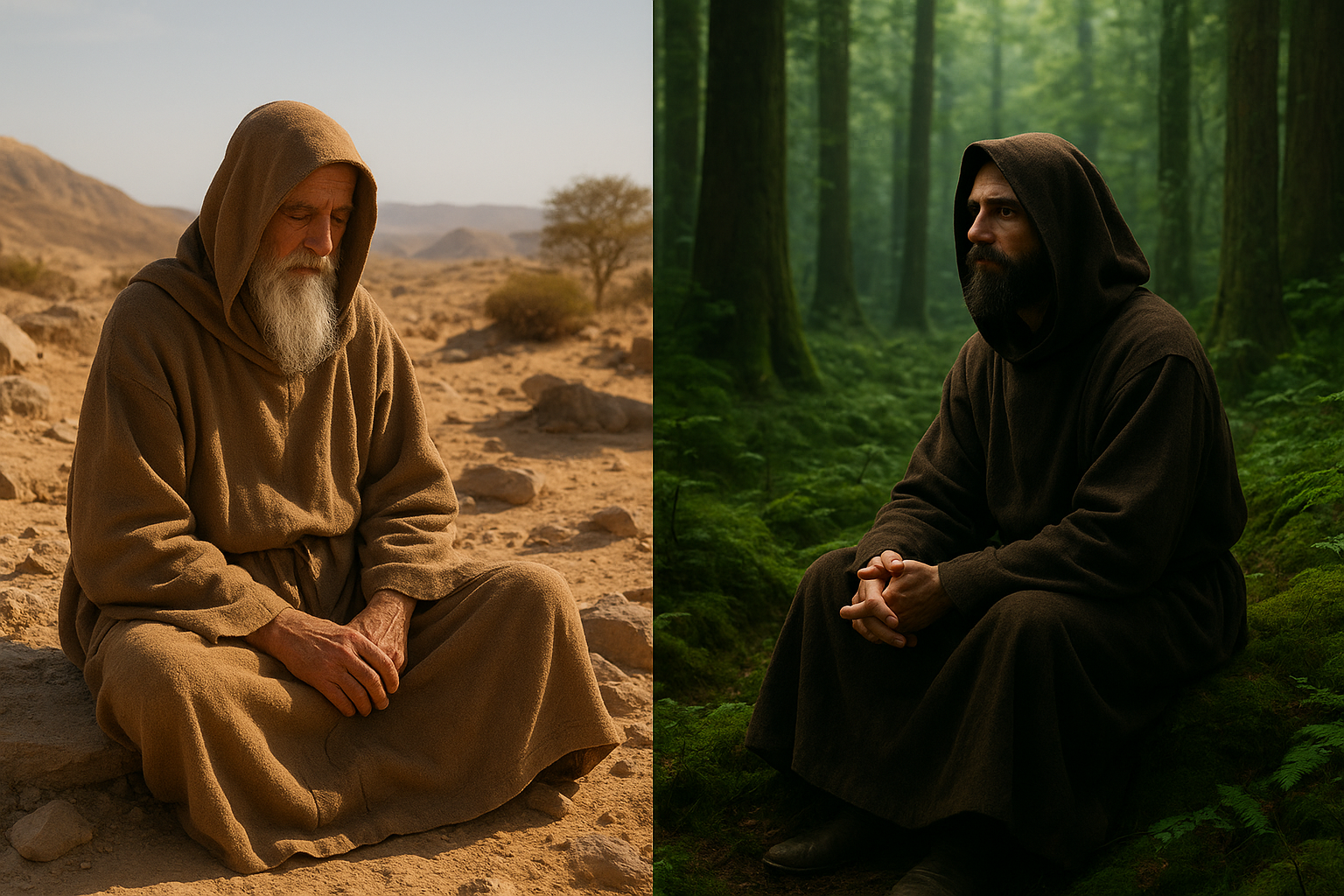
    Throughout history, humanity has sought meaning and enlightenment in solitude. Among the most fascinating examples of this pursuit are the mystical journeys of the Desert Fathers of early Christianity and the Forest Monks of Southeast Asia’s Buddhist traditions. Though separated by geography and culture, both groups highlight the profound role that solitude plays in spiritual and personal encounters with the divine and the self.

    The Desert Fathers: Fleeing the World to Find the World

    The Desert Fathers were Christian hermits who, starting in the third century, retreated to the deserts of Egypt. As Christianity began to merge with state power and grow in numbers, these individuals, seeking a purer form of devotion, isolated themselves to live a life of austerity and contemplation.

    “Go, sell what you possess and give to the poor, and you will have treasure in heaven; and come, follow me.” — Jesus Christ, Matthew 19:21

    Saint Anthony the Great, often called the ‘Father of All Monks’, epitomizes the ethos of the Desert Fathers. Rejecting a life of wealth, he chose the desolation of the desert where he struggled with temptations and inner demons, finding clarity and a deeper connection with God in the process. For them, emergence into the wilderness was not about abandoning the world, but rather transcending its distractions to encounter a greater reality.

    Practices and Wisdom

    • Silence and Prayer: Desert Fathers embraced silence as a path to spiritual enlightenment. Through prayer and quiet contemplation, they believed they could hear God’s voice more clearly.
    • Fasting and Manual Labor: These ascetic practices helped them cultivate discipline, humility, and detachment from material possessions.
    • Community and Solitude: While most lived as hermits, small gatherings occasionally formed, allowing for communal benefits of sharing wisdom while maintaining personal space.

    Their teachings emphasized simplicity, exemplified by one of the Desert Fathers, Abba Moses the Black, who famously said, “Sit in your cell, and your cell will teach you everything. This maxim appraises the notion that solitude itself becomes a teacher.

    The Forest Monks: Embracing the Wild for Awakening

    On the other side of the world, the Forest Tradition of Theravada Buddhism also places immense value on solitude. Originating in the 13th century, this tradition emphasizes living and meditating in forest environments as a means to attain deeper levels of mindfulness and insight into the nature of reality.

    “Do not dwell in the past, do not dream of the future, concentrate the mind on the present moment.” — Gautama Buddha

    The narrative of Ajahn Mun Bhuridatta exemplifies the Forest Monks’ way of life. A pivotal figure in modern Thai Buddhism, Ajahn Mun ventured deep into the forests, believing that nature, free from societal distraction, was the ideal setting for enlightening meditation and introspection.

    Principles and Practices

    • Mindfulness and Insight Meditation: The main practice involves mindfulness, where monks cultivate awareness in every posture, including walking meditation amid nature.
    • Simplicity and Detachment: Forest monks live with the bare minimum, focusing on shedding desires and attachments to material possessions.
    • Harmony with Nature: Living in the wild emphasizes interconnectedness with all living things and the impermanence of life.

    Ajahn Chah, another influential figure, echoed this belief by stating, “If we know how to be content, we’re at peace everywhere.” This philosophy emphasizes inner tranquility regardless of external circumstances—an echo to the silent teachings of the desert.

    Solitude as Transformation

    Both the Desert Fathers and the Forest Monks demonstrate an archetype that transcends cultural boundaries: the seeker of solitude who finds profound transformation. Their lives inspire a reassessment of solitude, not as loneliness or withdrawal, but as a space for deep encounter and transformation.

    Their legacies invite reflection on the role of solitude in modern life. In an era characterized by constant connectivity, the lessons from these ascetics encourage a balance—a return to self through silence, contemplation, and the embrace of simplicity.

    “In every walk with nature one receives far more than he seeks.” — John Muir

    Thus, solitude becomes not just a physical separation but a deeper communion with the self and, depending on one’s beliefs, the divine. It presents an opportunity to listen, learn, and ultimately transform.

    Conclusion: A Path Open for All

    The Desert Fathers and Forest Monks walked ancient paths whose lessons resonate today. Their journeys of solitude teach that stepping away from the chaos of daily life allows individuals to delve into themselves and the universe. As we look to their examples, we find that solitude is not an act of escapism but a brave endeavor to encounter the profound within and around us. For those in pursuit of meaning and clarity, the teachings of these ascetics offer a guiding light.

    For further reading on the Desert Fathers and their teachings, visit Stanford Encyclopedia of Philosophy – Asceticism. For insights into the practices of the Forest Monks, check out The Forest Tradition of Buddhism.

  • Meditation as Communion — Sitting in stillness, dwelling in the heart of all

    Meditation as Communion — Sitting in stillness, dwelling in the heart of all

    Meditation, an ancient practice with roots in various spiritual and religious traditions, has long been celebrated for its ability to foster peace and self-awareness. However, beyond personal benefits, meditation can also be understood as a form of communion—an act of sitting in stillness and connecting with the deeper essence of life.

    At its core, meditation invites practitioners to dwell in the heart of all. This practice transcends personal constraints, embracing a universal sense of consciousness that connects individuals with the world around them. In this space of stillness, many find a sense of oneness, a bond with the universe that is both profound and transformative.

    “The more regularly and the more deeply you meditate, the sooner you will find yourself acting always from a center of peace.”

    J. Donald Walters

    This concept of meditation as communion is echoed in traditions around the globe. For example, in the Buddhist practice of Anapanasati (mindfulness of breathing), the emphasis is on maintaining awareness of the breath as a means of connecting with the present moment and, ultimately, with all beings. This practice fosters a deep understanding that the breath is a shared experience, connecting us all in the cycle of life.

    • Interconnectedness: Meditation encourages the realization that all aspects of life are interconnected. By recognizing this, individuals may move towards more compassionate and mindful interactions with others.
    • Presence: In cultivating presence, meditation allows individuals to turn inward and reflect on their relationship with the world, fostering a sense of harmony and unity.
    • Awareness: Through heightened awareness, one can better perceive the threads that bind humanity together, nurturing empathy and understanding.

    In the words of Vietnamese Zen master Thich Nhat Hanh, “Breathing in, I calm my body. Breathing out, I smile. Dwelling in the present moment, I know this is the only moment.” Such teachings illustrate that the act of meditation is not just about personal enlightenment but also involves a communal aspect, where the individual finds solace and grounding within the community of all beings.

    By approaching meditation as a form of communion, practitioners may find that they are not merely searching for inner tranquility but are also contributing to the greater universal web of existence. As we sit in stillness, dwelling in the heart of all, we open ourselves to profound insights and connections that resonate across time and space.

    For further reading on the transformative power of meditation, explore resources such as Plum Village and the teachings of The Ananda Community.

  • Prayer Beads and Mala — Counting breaths, counting prayers, touching presence

    Prayer Beads and Mala — Counting breaths, counting prayers, touching presence

    Throughout centuries, humans have sought spiritual solace and focus through various practices, rituals, and objects. Among these, prayer beads and malas hold a significant place across different cultures and religions, providing a tangible means to support meditation, prayer, and communion with the divine. This article explores the multifaceted roles of prayer beads and malas in different spiritual traditions, highlighting their symbolic and practical importance.

    The Origins of Prayer Beads

    The history of prayer beads is as diverse as the human cultures that have adopted them. Used across the globe, the structured repetition facilitated by prayer beads aids in concentrating the mind and cultivating a deeper state of meditation.

    • Christianity: The rosary is perhaps the most famous string of prayer beads in Western Christianity. Each bead represents a prayer and allows the devotee to maintain focus while reciting sequences of mysteries, Hail Marys, and Our Fathers.
    • Islam: Known as misbaha or tasbih, Islamic prayer beads generally consist of 99 or 33 beads. They correspond to the 99 names of Allah, facilitating repetitive prayer known as dhikr — the remembrance of God.
    • Hinduism: Hindus use a strand known as japa mala, typically composed of 108 beads. The mala is used in the practice of japa meditation, where each bead is counted for each repeated mantra.
    • Buddhism: Similarly to Hinduism, Buddhists also use a 108-bead mala. It is employed in chanting mantras, facilitating focus and continuity in meditation.

    The Spiritual and Symbolic Significance

    While the visual and tactile aspects of prayer beads are essential in maintaining concentration, their symbolism transcends their practical use.

    “Prayer beads are not simply a counting tool. They represent a spiritual path in which each bead is a step towards deeper meaning and understanding of the universe.”
    Anonymous

    For practitioners, each bead serves as a placeholder for a deeper truth or spiritual insight. They symbolize the journey toward enlightenment and act as physical reminders of commitment to one’s practice and beliefs.

    Counting Breaths and Prayers

    Breath has been a focal point in many meditation practices worldwide. Coupling the power of mindful breathing with the tactile experience of using prayer beads integrates mind, body, and spirit.

    • Counting Breaths: Reflective of longer meditative practices, each bead can represent a deep, mindful breath, anchoring the practitioner in the present moment. Focusing on inhalation and exhalation, coupled with the rhythmic movement of beads through the fingers, can bring clarity and peace.
    • Counting Prayers: Every bead becomes an occasion for prayer or mantra recitation, amplifying spiritual intention. Whether silently or audibly, this practice allows for profound internal and external resonance.

    Touching Presence: The Tactile Connection

    Beyond their symbolic and spiritual implications, prayer beads provide a tactile foundation that is crucial for anchoring oneself in the practice. The texture and feel of the beads moving through one’s fingers offer a grounding effect, creating a tangible connection with the divine essence.

    “Touch is one of the first senses to develop in the womb, and one of the critical parts of our spiritual connection. When we touch each bead, it’s akin to touching the sacred mystery itself.”
    Pema Chödrön

    The continued use of prayer beads throughout history highlights their unparalleled ability to support spiritual growth and offer comfort. As an extension of one’s spiritual practice, they serve not only as a counting tool but as a conduit for divine connection and introspection.

    Conclusion

    Both ancient and modern practices affirm the importance of prayer beads and mala across varying religions and spiritual disciplines. They provide a structured, physical method for cultivating presence, directing intention, and engaging deeply with spiritual truths. Whether used for counting breaths, prayers, or intentions, they remind practitioners of the sacred path they tread upon and foster an enduring connection with the sacred divine.

    In today’s frenetic world, these humble strings of beads offer profound ways to unwind, focus, and deepen one’s relationship with oneself and the cosmos, reaffirming their timeless significance.

    For further reading, explore the extensive history and practices surrounding prayer beads in BBC’s guide to Prayer Beads.