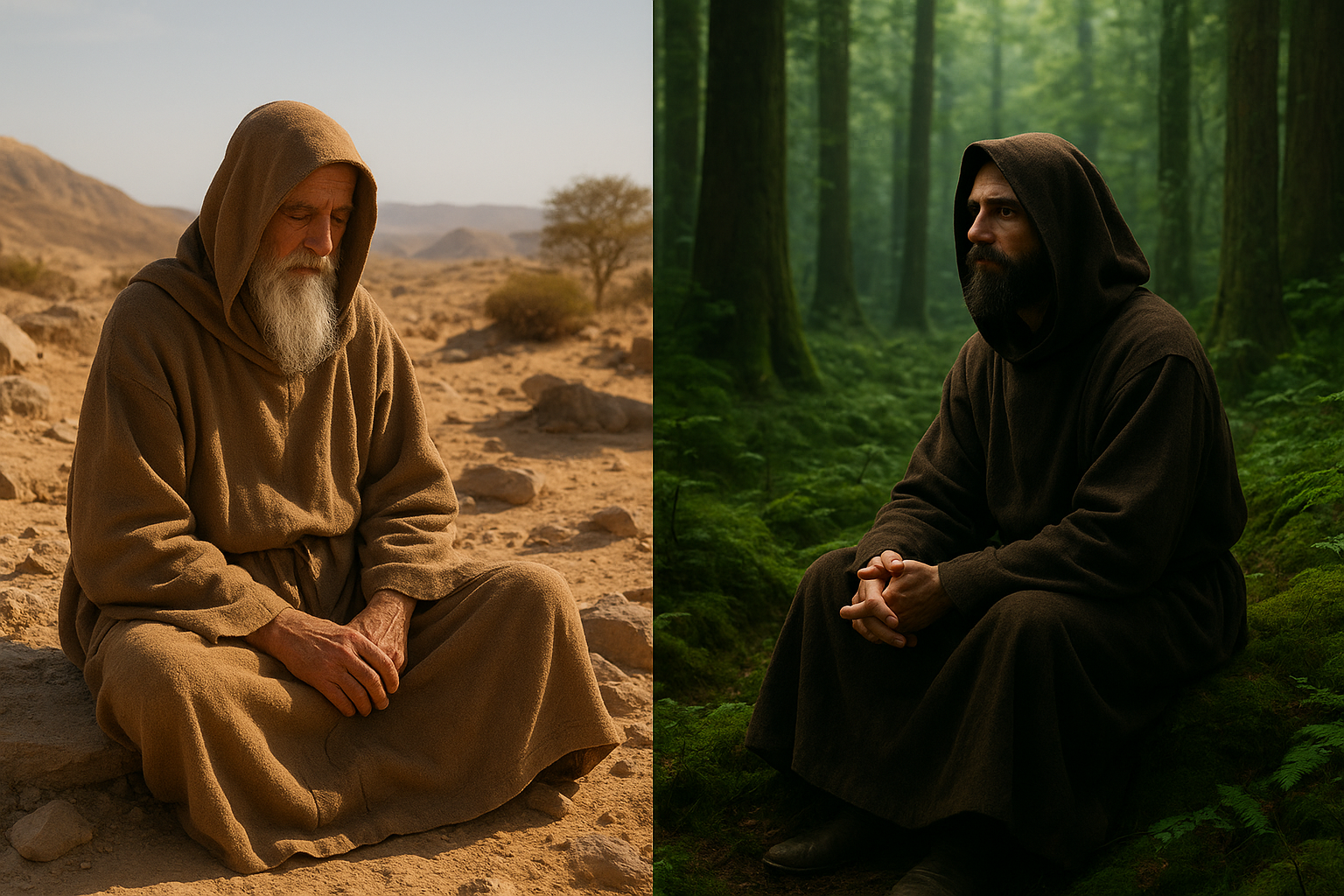
Desert Fathers and Forest Monks — Solitude as a Path to Encounter
Throughout history, humanity has sought meaning and enlightenment in solitude. Among the most fascinating examples of this pursuit are the mystical journeys of the Desert Fathers of early Christianity and the Forest Monks of Southeast Asia’s Buddhist traditions. Though separated by geography and culture, both groups highlight the profound role that solitude plays in spiritual and personal encounters with the divine and the self.
The Desert Fathers: Fleeing the World to Find the World
The Desert Fathers were Christian hermits who, starting in the third century, retreated to the deserts of Egypt. As Christianity began to merge with state power and grow in numbers, these individuals, seeking a purer form of devotion, isolated themselves to live a life of austerity and contemplation.
“Go, sell what you possess and give to the poor, and you will have treasure in heaven; and come, follow me.” — Jesus Christ, Matthew 19:21
Saint Anthony the Great, often called the ‘Father of All Monks’, epitomizes the ethos of the Desert Fathers. Rejecting a life of wealth, he chose the desolation of the desert where he struggled with temptations and inner demons, finding clarity and a deeper connection with God in the process. For them, emergence into the wilderness was not about abandoning the world, but rather transcending its distractions to encounter a greater reality.
Practices and Wisdom
- Silence and Prayer: Desert Fathers embraced silence as a path to spiritual enlightenment. Through prayer and quiet contemplation, they believed they could hear God’s voice more clearly.
- Fasting and Manual Labor: These ascetic practices helped them cultivate discipline, humility, and detachment from material possessions.
- Community and Solitude: While most lived as hermits, small gatherings occasionally formed, allowing for communal benefits of sharing wisdom while maintaining personal space.
Their teachings emphasized simplicity, exemplified by one of the Desert Fathers, Abba Moses the Black, who famously said, “Sit in your cell, and your cell will teach you everything. This maxim appraises the notion that solitude itself becomes a teacher.
The Forest Monks: Embracing the Wild for Awakening
On the other side of the world, the Forest Tradition of Theravada Buddhism also places immense value on solitude. Originating in the 13th century, this tradition emphasizes living and meditating in forest environments as a means to attain deeper levels of mindfulness and insight into the nature of reality.
“Do not dwell in the past, do not dream of the future, concentrate the mind on the present moment.” — Gautama Buddha
The narrative of Ajahn Mun Bhuridatta exemplifies the Forest Monks’ way of life. A pivotal figure in modern Thai Buddhism, Ajahn Mun ventured deep into the forests, believing that nature, free from societal distraction, was the ideal setting for enlightening meditation and introspection.
Principles and Practices
- Mindfulness and Insight Meditation: The main practice involves mindfulness, where monks cultivate awareness in every posture, including walking meditation amid nature.
- Simplicity and Detachment: Forest monks live with the bare minimum, focusing on shedding desires and attachments to material possessions.
- Harmony with Nature: Living in the wild emphasizes interconnectedness with all living things and the impermanence of life.
Ajahn Chah, another influential figure, echoed this belief by stating, “If we know how to be content, we’re at peace everywhere.” This philosophy emphasizes inner tranquility regardless of external circumstances—an echo to the silent teachings of the desert.
Solitude as Transformation
Both the Desert Fathers and the Forest Monks demonstrate an archetype that transcends cultural boundaries: the seeker of solitude who finds profound transformation. Their lives inspire a reassessment of solitude, not as loneliness or withdrawal, but as a space for deep encounter and transformation.
Their legacies invite reflection on the role of solitude in modern life. In an era characterized by constant connectivity, the lessons from these ascetics encourage a balance—a return to self through silence, contemplation, and the embrace of simplicity.
“In every walk with nature one receives far more than he seeks.” — John Muir
Thus, solitude becomes not just a physical separation but a deeper communion with the self and, depending on one’s beliefs, the divine. It presents an opportunity to listen, learn, and ultimately transform.
Conclusion: A Path Open for All
The Desert Fathers and Forest Monks walked ancient paths whose lessons resonate today. Their journeys of solitude teach that stepping away from the chaos of daily life allows individuals to delve into themselves and the universe. As we look to their examples, we find that solitude is not an act of escapism but a brave endeavor to encounter the profound within and around us. For those in pursuit of meaning and clarity, the teachings of these ascetics offer a guiding light.
For further reading on the Desert Fathers and their teachings, visit Stanford Encyclopedia of Philosophy – Asceticism. For insights into the practices of the Forest Monks, check out The Forest Tradition of Buddhism.