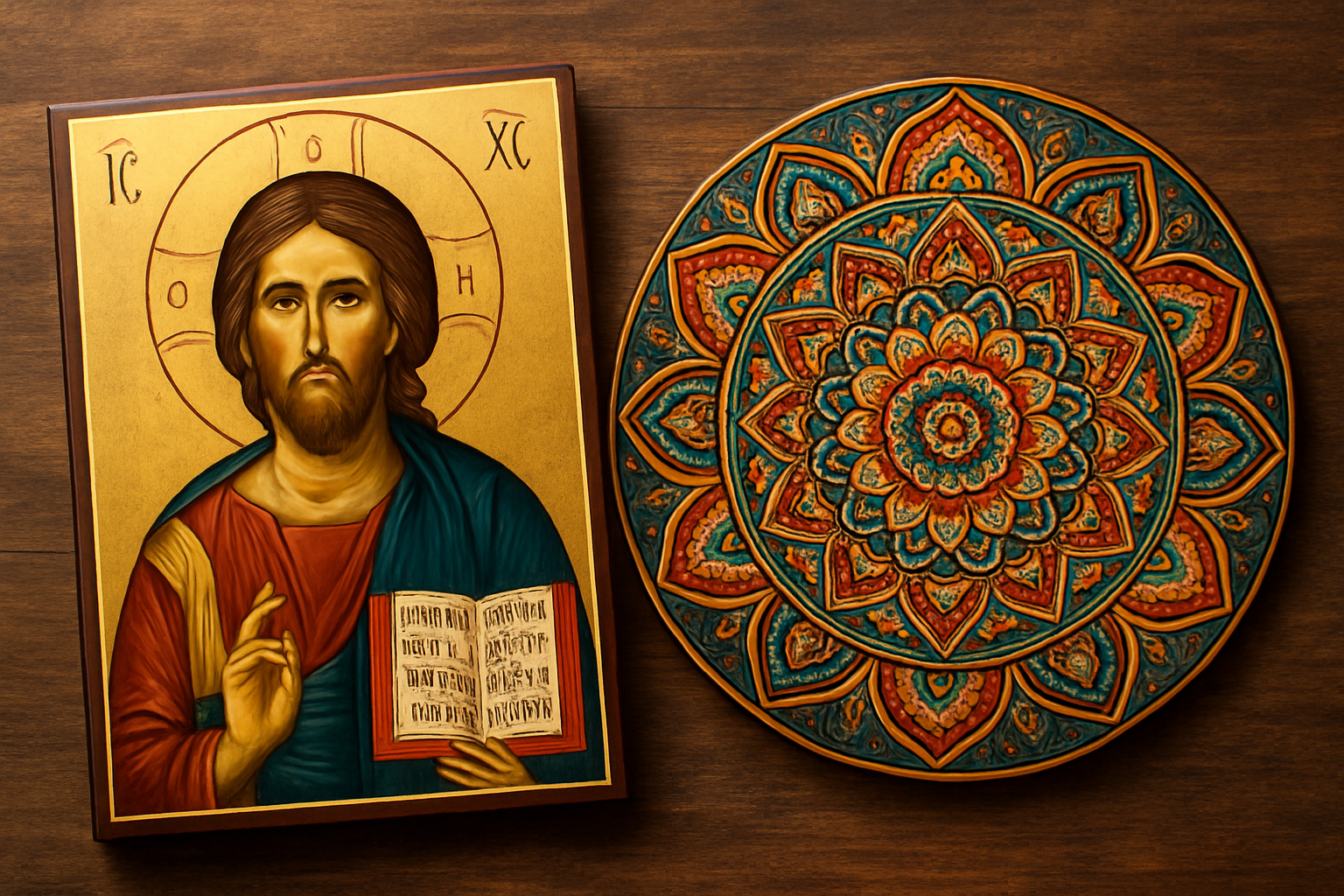
Throughout history, mankind has employed symbols and art forms to express concepts that transcend verbal communication. Among these, icons and mandalas stand out as powerful examples of metaphysical representation, each carrying profound significance in its respective cultural milieu.
The World of Icons
Icons, typically associated with religious art, serve as a visual language in many spiritual traditions. In Eastern Orthodox Christianity, for instance, icons are not mere depictions but are considered windows to the divine.
“An icon is a sacred image used in religious devotion… The icon is a means of spiritual communion between the viewer and the image.” — OrthodoxWiki
These sacred images, often rendered in a stylized manner with rich symbolism, invite the viewer into contemplation and prayer. Icons are not only art but are revered as expressions of theological insights, with each detail carrying a symbolic meaning understood by the believers.
The Mandala’s Encompassing Nature
Meanwhile, the mandala, often associated with Buddhist and Hindu traditions, offers a cosmic diagram of the universe. The word “mandala” comes from the ancient Indian language of Sanskrit and means “circle.”
“In various spiritual traditions, mandalas may be employed for focusing attention, as a spiritual teaching tool, or for establishing a sacred space.” — Encyclopaedia Britannica
Mandalas often take the form of intricate geometric patterns, symbolizing the universe’s structure and unity. They are used in meditation practices, guiding the practitioner’s focus inward and deeper into the spiritual realm. Drawing or gazing upon a mandala is said to aid in centering the mind and promoting spiritual healing and growth.
Universal Symbols of Unity
Both icons and mandalas invite individuals into an interaction with the infinite, creating a bridge between the earthly and the divine. While they originate from distinct cultural backgrounds, they share an underlying principle: they serve as instruments for personal transformation and paths to enlightenment.
- Icons articulate theological truths through visual storytelling.
- Mandalas illustrate the cosmic order through symmetrical patterns.
In a world often overwhelmed by too many words, these symbolic formats allow us to experience a purer, more profound understanding of our place within the cosmos. The eye-catching allure of icons and mandalas holds timeless appeal, perpetually inviting us to explore deeper spiritual dimensions beyond the realm of verbal expression.
For more on the symbolism of icons and mandalas, visit Orthodox Arts Journal and Shambhala Publications.